Route 66 Was Dying Before the Postcards Were Even Printed — What You're Driving Today Is Something Else Entirely
Route 66 Was Dying Before the Postcards Were Even Printed — What You're Driving Today Is Something Else Entirely
Every year, thousands of Americans load up a car, point it west, and set out to drive Route 66 — the "Main Street of America," the "Mother Road," the highway that supposedly captures something essential about who we are as a country. The diners, the neon signs, the wide-open stretches of desert asphalt. It feels timeless.
Here's the uncomfortable part: a lot of what you're looking at was rebuilt specifically so you'd feel that way.
What Route 66 Actually Was
When Route 66 was officially established in 1926, it wasn't romantic. It was practical. The highway connected Chicago to Los Angeles across 2,400 miles of mostly rural, often unpaved road, threading through small towns in Missouri, Kansas, Oklahoma, Texas, New Mexico, and Arizona before finally reaching California.
For the people who depended on it — migrants fleeing the Dust Bowl in the 1930s, truck drivers moving goods, families relocating west — Route 66 was functional infrastructure, not a lifestyle. John Steinbeck called it the "Mother Road" in The Grapes of Wrath, but he wasn't writing a travel brochure. He was describing desperate people using the only road available to them.
The highway thrived through the 1940s and into the 1950s, when postwar prosperity sent Americans driving in record numbers. Motels, diners, and roadside attractions bloomed along its length to serve that traffic. That era — roughly 1946 to 1965 — is what most people picture when they imagine Route 66. It was real, and it was genuinely vibrant.
But it didn't last long.
The Interstate Killed It — Slowly, Then All at Once
In 1956, President Eisenhower signed the Federal Aid Highway Act, launching the Interstate Highway System. Over the following two decades, new interstates systematically bypassed the towns that Route 66 ran through. Faster, straighter, and engineered for volume, the interstates pulled traffic away from the old road town by town.
The effect was brutal for communities that had built their economies around highway traffic. When I-40 bypassed Winslow, Arizona, the town didn't just lose tourists — it lost its reason to exist as a commercial stop. The same story played out in Tucumcari, New Mexico; Shamrock, Texas; and dozens of other towns along the route.
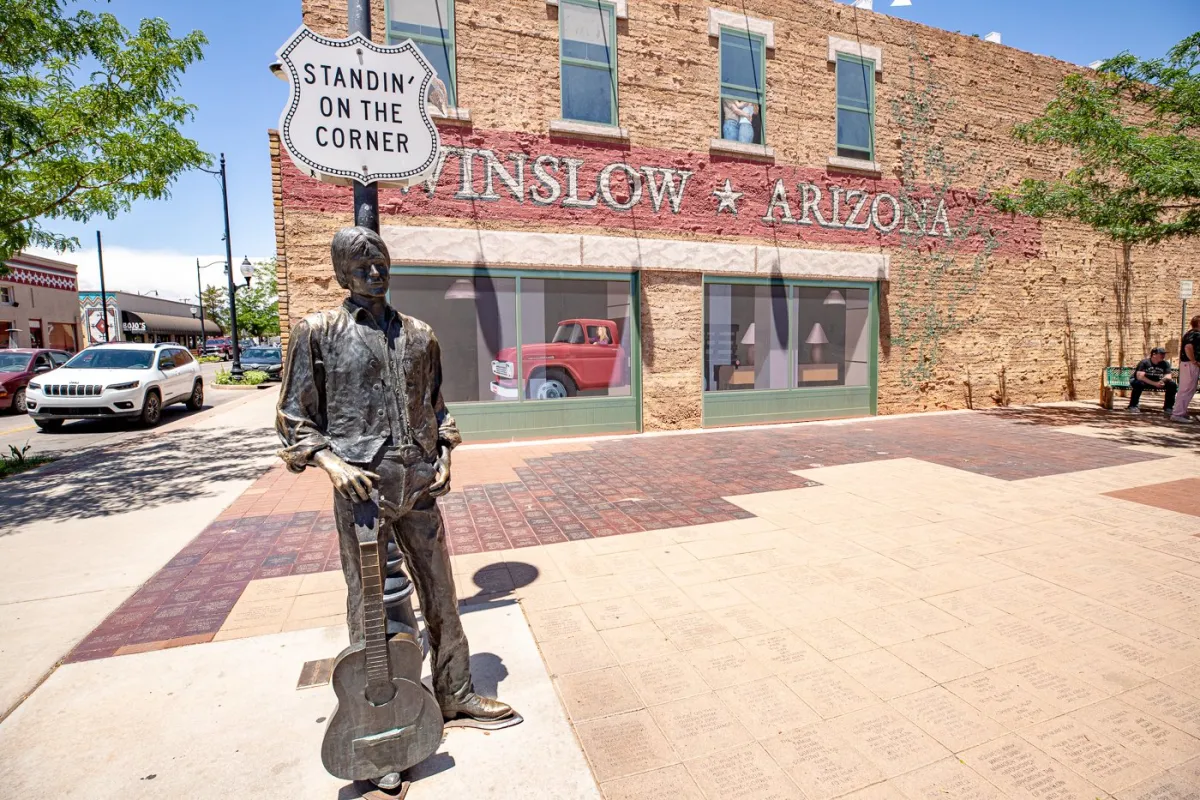 Photo: Winslow, Arizona, via route66roadmap.com
In 1985, Route 66 was officially decommissioned. Removed from the national highway map entirely. Not rerouted — deleted. The signs came down. The designation disappeared.
By that point, significant stretches of the original road were already gone — buried under interstate construction, absorbed into local roads with different names, or simply abandoned and left to crumble. The idea that you can drive the original Route 66 from Chicago to Los Angeles today isn't quite accurate. You can drive roads that follow roughly the same corridor. But continuous, uninterrupted, original Route 66 pavement? That doesn't exist anymore in any complete sense.
How the Nostalgia Industry Moved In
Something interesting happened after the decommissioning. Almost immediately, people started mourning the road. The Route 66 Association was founded in 1990. States began designating surviving segments as historic byways. The National Park Service got involved. Preservation groups raised money to restore the neon signs that had gone dark.
This wasn't purely organic sentiment. It was also economic strategy.
The towns that had been hollowed out by the interstates recognized that the Route 66 mythology — the Americana aesthetic, the road trip romance, the Steinbeck associations — was a marketable asset. If people couldn't drive through for practical reasons, maybe they'd drive through for sentimental ones.
So restoration began. Not restoration of a working highway, but restoration of the idea of Route 66. Vintage signs were repainted or replaced with period-accurate reproductions. Diners were refurbished to look the way they might have in 1955. Some attractions that had closed were reopened specifically for tourism. New businesses opened designed to look old.
In Seligman, Arizona — often called the "Birthplace of Historic Route 66" — a local barber named Angel Delgadillo became the face of the preservation movement after lobbying Arizona to designate surviving segments as a historic highway. His efforts were genuine and his advocacy was real. But the result was a town that now functions almost entirely as a Route 66 experience rather than a working community that happens to be on a road.
That distinction matters.
What You're Actually Seeing When You Drive It
None of this means the Route 66 experience is fake in any simple sense. The landscape is real. The distance is real. Many of the surviving buildings are genuinely old. And some of the people running the roadside stops have deep, authentic connections to the highway's history.
But the experience has been curated in ways most travelers don't fully register. The "spontaneous" roadside America you're discovering was largely staged for your arrival. The patina is real; the context has been carefully managed.
International tourists — particularly from Germany, the UK, and Japan, who make up a surprisingly large share of Route 66 visitors — often arrive with a vision of American freedom and open-road mythology that the tourism infrastructure is very happy to sell them. The mythology travels better than the history does.
The Road Worth Taking Anyway
Here's the honest version: Route 66 is still worth driving. The scenery across New Mexico and Arizona is extraordinary. Some of the surviving diners serve genuinely good food. The small towns have real stories, even if those stories are more complicated than the souvenir shops suggest.
But it's worth knowing what you're actually looking at. You're not stepping back into 1955. You're visiting a living museum built around a highway that was already disappearing before most of its mythology was even written. The real Route 66 story — the Dust Bowl migrants, the postwar boom, the slow erasure by the interstates — is more interesting than the neon signs let on.
That story is still out there, if you know to look for it.