The Farmers Market Isn't Lying to You — But It Isn't Telling You Everything Either
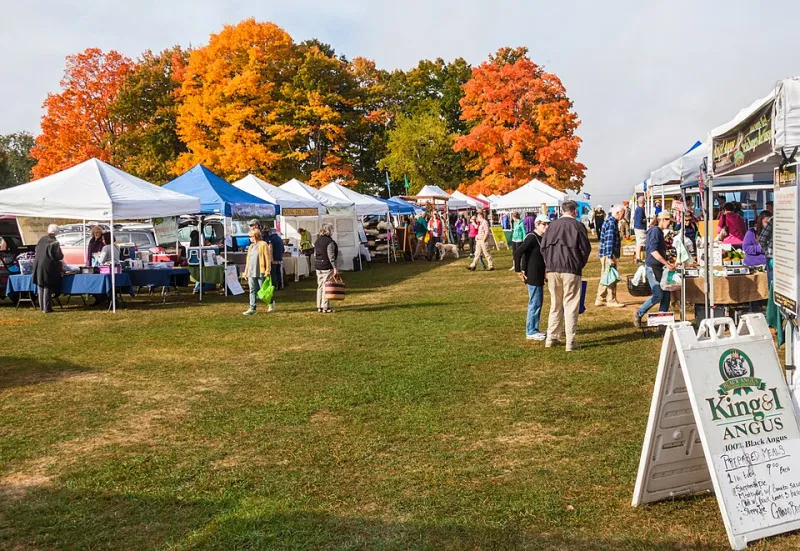
Photo: Paul VanDerWerf from Brunswick, Maine, USA, CC BY 2.0, via Wikimedia Commons
There's a particular feeling that comes with a Saturday morning farmers market. The canvas bags, the heirloom tomatoes stacked in wooden crates, the person behind the table who seems to genuinely know where the food came from. For a lot of Americans, it's one of the most trustworthy food experiences they can have — a direct line between the person who grew something and the person who's going to eat it.
That experience is real, and it matters. But the word hovering over almost every table — local — doesn't mean what most people assume it does. And understanding the gap between the feeling and the reality doesn't ruin the farmers market. It just gives you a clearer picture of what you're actually buying.
'Local' Has No Legal Definition
This is the foundational fact that most farmers market regulars have never heard: there is no federal or state legal definition for the word "local" when it comes to food. The USDA has acknowledged this explicitly. Unlike "organic," which requires third-party certification and compliance with specific standards, "local" can mean whatever the person using it decides it means.
For some vendors, local means within 25 miles. For others, it means within the same state — which in Texas covers roughly 268,000 square miles. Some markets have their own internal rules about vendor geography; others don't. A few large urban markets in cities like New York and Los Angeles have been documented allowing vendors from hundreds of miles away to sell under the general umbrella of "locally sourced."
None of this is necessarily deceptive in a legal sense. But it is a meaningful gap between what the marketing implies and what the supply chain sometimes looks like.
The Market Rules Vary Wildly
Farmers markets in the United States are managed by a loose patchwork of entities — nonprofit organizations, city parks departments, private companies, and agricultural cooperatives. Each sets its own vendor rules, and those rules vary enormously.
Some markets are genuinely strict. Producer-only markets require that every vendor sell only what they grew or made themselves, and they conduct farm visits to verify it. These markets tend to be smaller, more seasonal, and sometimes more expensive — because they're reflecting the actual cost of small-scale local production.
Other markets operate more loosely. A vendor might grow some of what they sell and purchase the rest from a wholesale distributor to fill out their table. This practice, sometimes called "reselling" or "booth filling," is more common than most shoppers would guess. It's not always prohibited by market rules, and it's rarely disclosed to customers browsing the stalls.
Then there are markets that allow vendors who operate at a scale that would surprise most people standing across the table from them. A farm with thousands of acres and regional distribution contracts is technically a farm — and if it falls within whatever geographic boundary the market uses, it qualifies as local. The mental image of a small family operation doesn't always match the business behind the booth.
Why the Experience Feels More Personal Than It Sometimes Is
Farmers markets are extraordinarily good at creating intimacy. The physical setup — outdoor stalls, direct conversation, visible produce — mimics the aesthetic of small-scale agriculture even when the reality is more complicated. Consumers consistently report higher trust in food bought at farmers markets than food bought in grocery stores, regardless of whether they know anything specific about the vendor.
Marketers and food researchers have studied this phenomenon. The presence of a human being behind a table, the ability to ask questions, and the visual cues of rusticity all trigger what researchers call "source credibility" — a sense that the person selling you something has a direct, accountable relationship with what they're selling. That feeling is real and valuable. But it can persist even when the actual supply chain doesn't match the setting.
Some vendors are entirely transparent about their sourcing. Others lean into the aesthetic without volunteering information that would complicate it. Neither behavior is necessarily dishonest — but the gap between what the setting implies and what's actually happening is worth knowing about.
What's Actually Worth Celebrating
Here's where the story gets genuinely complicated in a good way: a lot of what makes farmers markets valuable has nothing to do with whether the food traveled 15 miles or 150.
Farmers markets create direct economic relationships between producers and consumers that bypass several layers of the industrial food supply chain. Even when a vendor operates at a larger scale, the money paid at that table flows differently than money spent at a grocery store. Markets support regional food economies, preserve agricultural land from development, and maintain a diversity of crop varieties that industrial agriculture has largely abandoned.
The food at a farmers market — even from a larger operation — is often harvested closer to peak ripeness than supermarket produce, which gets picked early to survive long-distance shipping. The tomato you bought this morning probably does taste better. That part isn't marketing.
And the small, genuine family operations that markets were originally built around are absolutely still there. They just share table space with a more varied cast of vendors than the marketing typically acknowledges.
The Takeaway
The farmers market experience is worth having. The food is often better, the economic relationships are often more direct, and the connection to regional agriculture is real. What's worth adjusting is the assumption that "local" means something specific and verified — because it doesn't, and the rules governing who can sell what vary more than most shoppers ever think to ask about.
The best thing you can do at a farmers market is also the most natural one: ask questions. The vendors who know their answers cold are usually the ones who grew what they're selling.